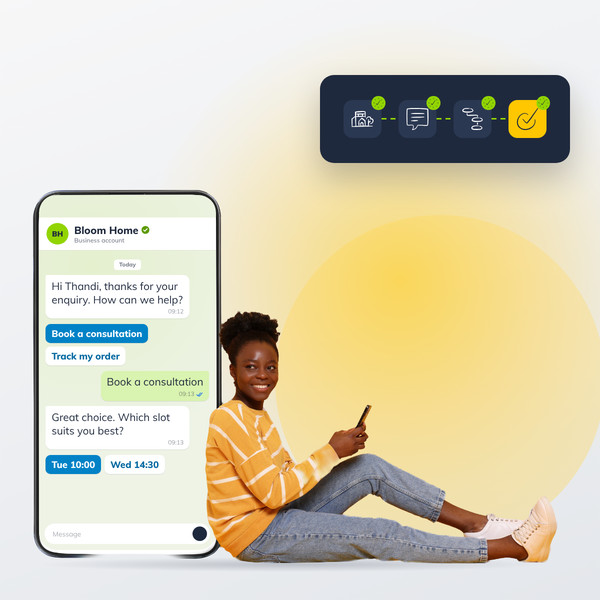
The right WhatsApp Business solution depends on what your customers need to do, how much automation your business requires and who will manage the work behind it.
For straightforward customer enquiries, the WhatsApp Business app may be enough. For automated conversations, integrations or more complex customer journeys, the WhatsApp Business Platform offers greater flexibility. From there, you decide whether to build and manage the solution internally, use ready-made software or work with a managed-service provider.
Here’s how to make that choice.
Start With What Your Customers Need
A customer messages your business on WhatsApp at 8 pm. They want to know whether you can help, but your team has finished for the day.
Should they receive an automated acknowledgement? Would it help to capture their enquiry details? Could an automated conversation guide them to the right service before passing the enquiry on to someone the next morning?
The answer determines what your WhatsApp solution needs to do.
Not every business needs a chatbot, AI or complex integrations. A simple enquiry might only need an acknowledgement and a clear handover. A more involved process could require automated questions, customer information, integration with an existing system and defined escalation rules.
Start with the customer task, not the technology. Then decide who has the expertise and capacity to build, operate and maintain the experience.
WhatsApp Business App or WhatsApp Business Platform?
There are two main starting points.
The WhatsApp Business app is designed for businesses that manage customer conversations using built-in features such as business profiles, greeting messages and away messages. It’s a practical starting point for smaller operations with straightforward communication requirements.
The WhatsApp Business Platform, often called the WhatsApp Business API, supports more advanced messaging, automation and integrations. Businesses can connect it to compatible software, build custom workflows or use a specialist provider.
Moving to the Platform doesn’t automatically mean your business needs developers. The implementation approach determines how much technical responsibility remains with your team.
Six Ways to Get WhatsApp Business Working
Once you understand the capabilities you need, compare how the solution will be delivered.
The following six routes represent common implementation and service approaches. They aren’t mutually exclusive, and providers may combine several.
| Option | Best suited to | Who does the work? |
| WhatsApp Business app | Straightforward conversations using built-in tools | Your team manages customer communication and the channel |
| Custom Platform build | Bespoke workflows and integrations | Your developers or implementation partner build the solution; ongoing maintenance must be assigned |
| Ready-made software | Businesses wanting campaign tools, automated flows or shared inboxes | The provider supplies the software, while your team may handle configuration and ongoing changes |
| Software with specialist services | Businesses needing software with implementation assistance or management support | Responsibility is shared according to the service agreement |
| CRM or contact-centre solution | Conversations connected to existing customer records and service processes | Your systems team, provider or implementation partner manages the configuration |
| Managed WhatsApp solution | Businesses wanting specialists to implement and manage an agreed solution | The provider handles defined specialist work, while your business retains objectives, approvals and customer relationships |
The important difference isn’t simply which solution offers more features. It’s how much work your business will need to take on to make those features useful.
Three Checks Before You Choose
1. Match the Solution to the Customer Task
Define what a successful conversation should achieve. Are you answering frequently asked questions, capturing enquiries, sending service updates or guiding customers through a more involved process?
Identify the information customers need, the questions they may ask and the circumstances in which a person must step in.
This gives you a practical brief against which to evaluate different solutions.
2. Establish Who Owns the Work
Access to a platform is not the same as having a working WhatsApp experience.
Depending on your requirements, someone must:
- Complete the necessary account and phone-number setup.
- Design conversation flows and customer handovers.
- Prepare message templates for Meta approval where required.
- Manage customer permissions and relevant compliance requirements.
- Configure integrations where necessary.
- Test conversations, including incomplete answers and exceptions.
- Maintain and update the experience after launch.
Some providers supply software and leave this work to your team. Others offer implementation support or manage defined responsibilities for you.
Before choosing a provider, make sure you know where its responsibilities end, and yours begin.
3. Compare the Total Cost, Not Just the Subscription
The most affordable software subscription isn’t necessarily the least expensive way to operate WhatsApp Business.
Compare the costs of delivering the same customer task over the same period.
Include setup and implementation, software or service subscriptions, applicable Meta messaging charges, changes after launch and the internal time required to manage the solution.
A custom build may offer greater control if you have the technical resources to maintain it. A managed solution may make more sense when your team needs specialist implementation and ongoing support.
Neither approach is universally better. The right choice depends on what your business wants to manage internally.
What Does a Managed WhatsApp Solution Look Like?
A managed solution goes beyond providing access to the WhatsApp Business Platform.
For example, Everlytic offers managed WhatsApp Business services through AI Studio. Its specialists work with businesses to translate communication requirements into automated conversations, with design, implementation and ongoing management within the agreed scope.
The business remains responsible for its objectives, approvals, required access and customer relationships. Human customer-service replies also remain with the business unless the service agreement states otherwise.
An Example: Using WhatsApp to Support Successful Communication in Event Management
Brand Launch Solutions used Everlytic AI Studio to support communication before, during and after a major event.
Working with Everlytic, the team developed interactive WhatsApp conversations that helped attendees find information, receive updates, and navigate the event. Conversations were refined as attendee needs became clearer.
The implementation supported more than 90,000 WhatsApp interactions during the event, while more than 60% of attendees engaged with WhatsApp broadcasts.
This example demonstrates why selecting a WhatsApp solution involves more than comparing software features. Planning, conversation design, and ongoing adjustments were key parts of the delivery.
Read the Brand Launch Solutions case study
Five Questions to Ask a WhatsApp Business Provider
Before committing to a provider, establish the answers to these questions:
- What is included in implementation? Confirm who handles account setup, conversation design, configuration and testing.
- Who manages message templates and approvals? Understand the process when a template needs to be revised or resubmitted.
- What happens when a customer needs a person? Confirm how conversations are handed over and who responds.
- Who maintains the solution after launch? Ask who updates workflows when your business processes change.
- What will the solution cost over time? Request a breakdown of technology fees, messaging charges, management services and changes outside the agreed scope.
The answers should give you a clearer picture of the operational commitment behind each proposal.
Choose a Solution Your Team Can Sustain
The best WhatsApp Business solution isn’t necessarily the one with the most features. It’s the one that supports your customer communication requirements without creating an operational commitment your team cannot maintain.
Start with the customer task. Establish who owns the implementation and ongoing work. Then compare the complete cost of delivering the experience.
If your business needs more than access to the technology, a managed approach may offer a more sustainable route.
Chat with Us
Frequently Asked Questions
Do I Need Developers to Use WhatsApp Business Automation?
Not necessarily. A custom integration requires development resources, but suitable software or a managed provider can reduce the technical work your business needs to undertake.
Is a Managed WhatsApp Business Solution Better Than Self-Service Software?
It depends on your team’s capabilities and priorities. Self-service software can be a good fit when you want direct control and have the resources to configure and maintain it. Managed delivery is worth considering when specialist work would otherwise compete with your team’s core responsibilities.
Does a Managed WhatsApp Provider Reply to Customers for Me?
Not necessarily. Managing the technology, automation and workflows is different from supplying customer-service agents. Confirm whether human responses are included in your agreement.